Copyright 2023 - Designed & Developed by Frenify



Electron Transport and Free Radicals
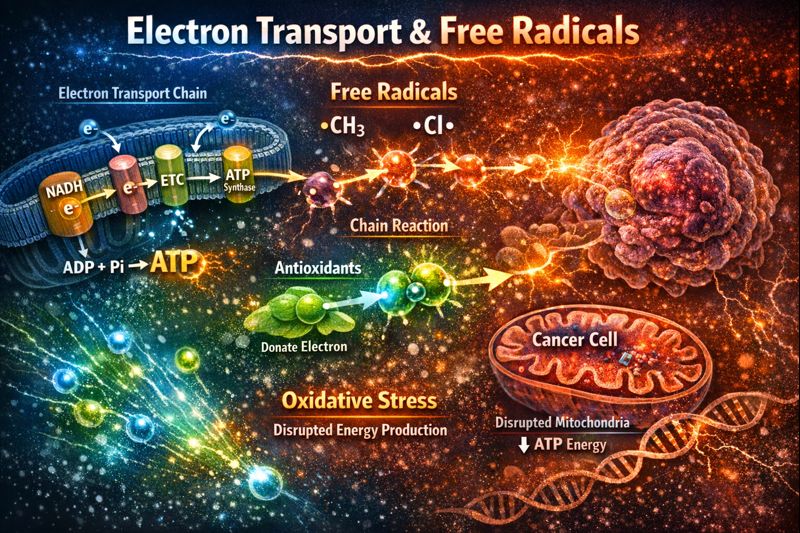
The most comprehensive and significant aspect in the context of diseases, including cancer, is the science of free radicals in the human body. Free radicals contain an unpaired number of electrons, such as the methyl or chlorine radical. It is well known that covalent homolytic bonds break in a manner that allows each fragment to retain one electron.
Free radicals can trigger chain reactions that persist for thousands of cycles before they are terminated. Antioxidants are the most common “terminators” of these reactions, offering an additional electron needed by free radicals to complete their electron shell.
In the context of electron transport within the Krebs cycle, it is assumed that free radicals can interfere with the electron transfer process before reaching the mitochondria, thereby reducing energy metabolism. Dr. William Koch demonstrated that “polymerizing low-molecular-weight unsaturated free radicals strongly stimulate cancer development.”
Hypothetically, MWO devices may deliver abundant amounts of free electrons and negative ions into the human body. Such a wave of free electrons, penetrating permeable membranes in tissues, muscles, and bones, may not only halt chain reactions but also force ATP production in the Krebs cycle back into the respiratory cycle. Cancer cells, unable to tolerate the respiratory cycle and its high oxygen content, undergo immediate destruction. The subsequent toxin elimination process may require short sessions with MWO devices and detoxification periods.